信息与软件工程学院上机实验报告
(第 3 次)
### 一、实验名称
请求页式存储管理中常用页面置换算法模拟
------
### 二、实验目的及要求
#### 实验目的
1. 了解内存分页管理策略。
2. 掌握调页策略。
3. 掌握一般常用的调度算法。
4. 学会各种存储分配算法的实现方法。
5. 了解页面大小和内存实际容量对命中率的影响。
#### 实验要求
1. 采用页式分配存储方案,通过分别计算不同算法的命中率来比较算法的优劣,同时也考虑页面大小及内存实际容量对命中率的影响;
2. 实现 OPT(最优置换)、LRU(最近最久未使用)、FIFO(先进先出)算法的模拟;
3. 会使用某种编程语言实现并验证结果。
------
### 三、实验环境
- 开发语言:C++
- 实验环境:Linux (Ubuntu 24.04 LTS)
- 编译工具:g++ (C++17)
------
### 四、实验设计
#### 1. 实验步骤
##### 设计思想
本实验实现一个“页面置换算法模拟器”,支持三种经典算法:
- FIFO(先进先出):淘汰最早进入内存的页面,使用队列维护进入顺序;
- LRU(最近最久未使用):淘汰最近最久未被访问的页面,使用链表 + 哈希位置实现精确 LRU;
- OPT(最优置换):理论最优,淘汰未来最久才会访问(或不再访问)的页面,作为评估基准。
模拟器支持两种输入方式:
- 直接输入“页号序列”;
- 输入“字节地址序列 + 页面大小”,自动换算为“页号序列”。
可设置“内存页框数”,输出命中次数、缺页次数、置换次数、命中率,并可选打印“逐步状态表”,便于观察每次访问后的内存帧内容。另提供“参数扫描”,观察页面大小与页框数对命中率的影响。
##### 核心数据结构
- `Stats`:统计指标
- `refs`(访问总次数)、`hits`(命中次数)、`faults`(缺页次数)、`replacements`(置换次数)。
- 内存帧表示
- 使用 `vector frames` 表示当前各帧中的页号(-1 表示空);
- 可选的二维表 `frames2D[frame][time]` 用于记录每一步后的帧状态,打印“逐步状态表”。
- 算法辅助结构
- FIFO:`queue order` + `unordered_set inMem`;
- LRU:`list lruList` + `unordered_map::iterator> pos`;
- OPT:在发生缺页且内存已满时,线性扫描每个候选帧,向后查找其“下一次被访问”的时间,选择最晚者为淘汰页。
##### 算法流程
###### FIFO(先进先出)流程
 ---
###### LRU(最近最久未使用)流程
 ---
###### OPT(最优置换)流程
 #### 2. 调试过程与实验结果
##### 测试数据
```text
1,0,1,0,2,4,1,0,0,8,7,5,4,3,2,3,4
```
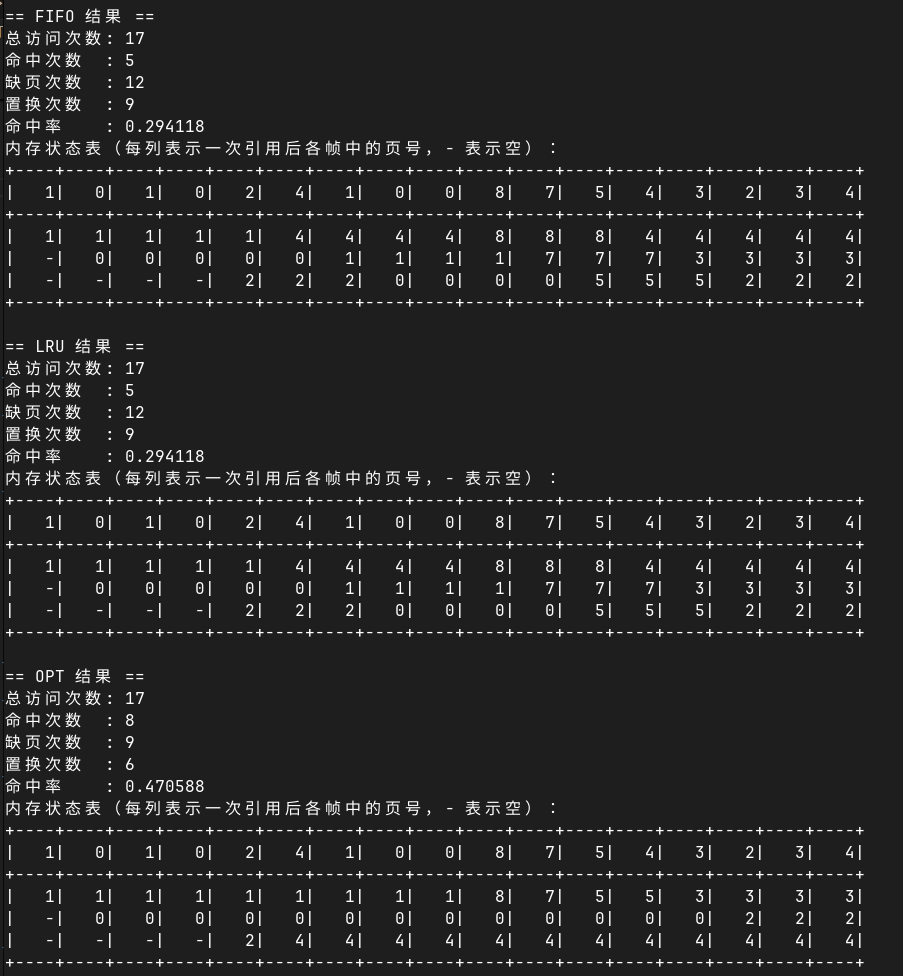
##### 执行结果(页框数 = 3,打印逐步状态表)
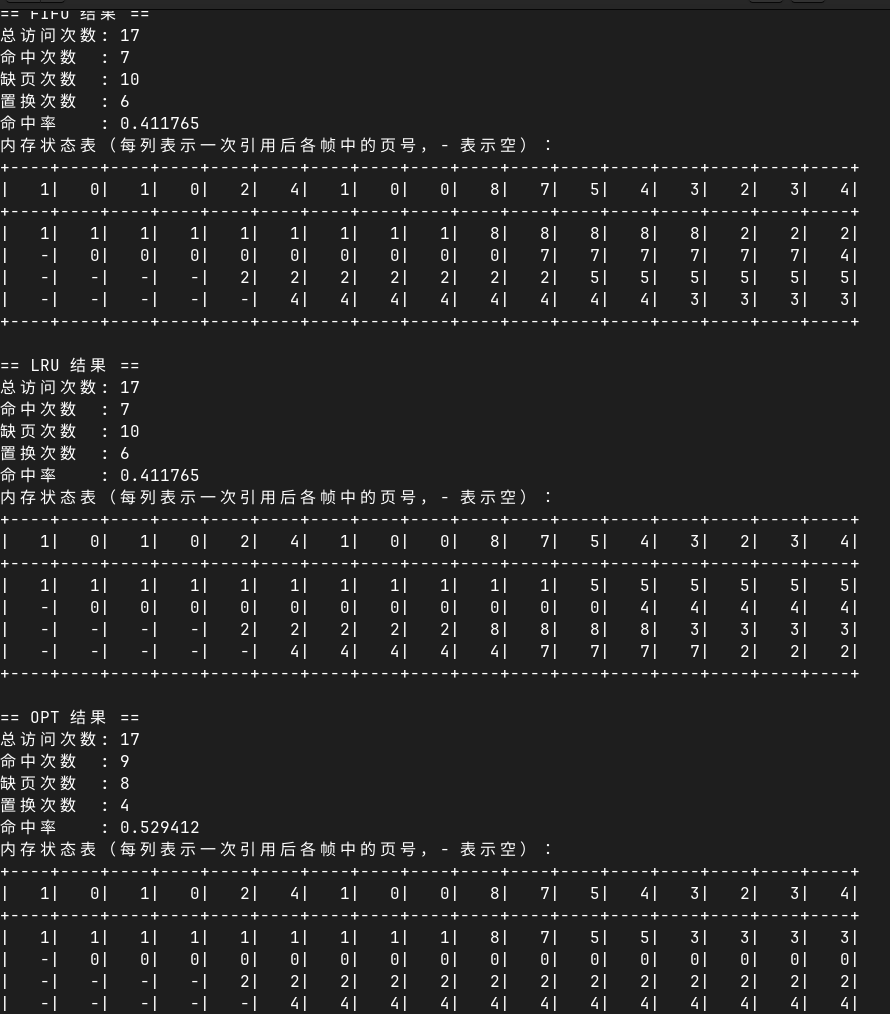
##### 执行结果(页框数 = 4,使用默认样例)
#### 3. 结果分析与总结
##### 结果分析
- 在相同序列下,命中率趋势通常为:`OPT ≥ LRU ≥ FIFO`;
- 页框数越多,命中率通常越高(Belady 异常在本样例中未出现);
- 页面大小越大(对同一地址序列),页号序列更短、更易重复,命中率提升明显,但实际系统需权衡内部碎片与 I/O 放大。
------
##### 思考题
1. 为什么在实际系统中不直接使用“精确 LRU”,而使用“近似 LRU”?
- 精确 LRU 需要记录每次访问的全局次序(链表/时间戳/寄存器等),硬件或软件开销大;
- 实际系统常用访问位(Reference Bit)或 CLOCK 等近似算法,以更低开销取得接近 LRU 的效果。
2. OPT 算法为什么难以实现?
- 需要知道“未来”的访问情况,运行时不可获知;
- 仅作为理论最优的评估基准,用于对比其他算法的上限表现。
------
##### 心得体会
通过本实验,我实现并对比了 FIFO、LRU 与 OPT 三种页面置换算法,直观观察了“页面大小”和“内存页框数”对命中率的影响。实验验证了局部性原理对命中率的显著提升,同时也体会到算法选择与系统开销之间的权衡:
- FIFO 实现与理解最简单,但对局部性把握较弱;
- LRU 在多数实际工作负载上表现良好,但精确实现成本高,通常以近似方案替代;
- OPT 提供理论下限,有助于评估其他算法的潜在改进空间。
在实现过程中,我重点完善了“逐步状态表”和“参数扫描”,帮助从微观与宏观两个层面分析算法行为与命中率趋势。
##### 改进意见
扩展更贴近实际的访问轨迹,并加入冷热混合工作集的简短测试。
------
#### 4. 附录
```cpp
#include
#include
#include
#include
#include
#include
#include
#include
#include
#include
#include
using std::cin;
using std::cout;
using std::endl;
using std::list;
using std::queue;
using std::size_t;
using std::string;
using std::unordered_map;
using std::unordered_set;
using std::vector;
// ------------------------- 辅助数据结构与工具函数 -------------------------
// 统计结果结构体
struct Stats {
int refs = 0; // 引用总次数(访问次数)
int hits = 0; // 命中次数
int faults = 0; // 缺页次数(= 引用次数 - 命中次数)
int replacements = 0; // 置换次数(仅当内存满且发生缺页时才会置换)
};
// 打印一条分隔线,用于表格可读性
static void printDivider(int columns) {
// 每一列形如 | xx ,宽度大概 4-5 个字符
for (int i = 0; i < columns; ++i) {
cout << "+----"; // 简化为 4 个横线
}
cout << "+" << endl;
}
// 将以空格/逗号分隔的一行整数,解析为 vector
static vector parseIntList(const string &line) {
vector nums;
std::stringstream ss;
// 将逗号替换为空格,便于统一解析
for (char ch : line) {
if (ch == ',') ss << ' ';
else ss << ch;
}
int x;
while (ss >> x) nums.push_back(x);
return nums;
}
// 将“字节地址序列”按“页面大小”转换成“页号序列”
static vector addressesToPages(const vector &addresses, int pageSize) {
vector pages;
pages.reserve(addresses.size());
for (int addr : addresses) {
if (addr < 0) addr = 0; // 简单防御:负数地址按 0 处理
pages.push_back(addr / pageSize);
}
return pages;
}
// 打印“逐步状态表”:
// columns: 引用次数
// frames 2D: 每次访问后的内存帧内容,维度 = [frameCount][refs]
// refsList: 原始引用(页号)序列,仅用于首行显示
static void printTimelineTable(const vector> &frames2D,
const vector &refsList) {
int frameCount = (int)frames2D.size();
int refs = refsList.empty() ? 0 : (int)frames2D[0].size();
if (frameCount == 0 || refs == 0) return;
cout << "内存状态表(每列表示一次引用后各帧中的页号,- 表示空):" << endl;
printDivider(refs);
// 第一行:引用序列
for (int j = 0; j < refs; ++j) {
cout << "|";
// 宽度控制简单化,保证可读
cout.width(4);
cout << refsList[j];
}
cout << "|" << endl;
printDivider(refs);
// 后续行:每一帧在各次访问后的内容
for (int i = 0; i < frameCount; ++i) {
for (int j = 0; j < refs; ++j) {
cout << "|";
cout.width(4);
int v = frames2D[i][j];
if (v < 0) cout << "-"; // -1 用 - 展示
else cout << v;
}
cout << "|" << endl;
}
printDivider(refs);
}
// ------------------------------ 算法模拟实现 ------------------------------
// FIFO 先进先出置换算法
static Stats simulateFIFO(const vector &pages, int frameCount,
bool recordTimeline,
vector> *outFrames2D) {
Stats st;
st.refs = (int)pages.size();
if (frameCount <= 0) return st;
// 使用队列记录进入顺序;使用集合/字典判断是否在内存中
queue order;
unordered_set inMem;
// 用数组记录所有时刻的内存状态(仅在需要时)
vector> frames2D;
if (recordTimeline) {
frames2D.assign(frameCount, vector(st.refs, -1));
}
// 当前内存内容也用一个 vector 维护(便于输出)
vector frames(frameCount, -1);
int filled = 0; // 已使用的帧数
for (int t = 0; t < st.refs; ++t) {
int p = pages[t];
bool hit = (inMem.find(p) != inMem.end());
if (hit) {
st.hits++;
} else {
st.faults++;
if (filled < frameCount) {
// 还有空闲帧,直接装入
frames[filled] = p;
order.push(p);
inMem.insert(p);
filled++;
// 没有发生“置换”,因为没有淘汰任何页面
} else {
// 需要置换:淘汰最早进入的页面(队列头)
int victim = order.front();
order.pop();
inMem.erase(victim);
st.replacements++;
// 在 frames 中找到 victim 的位置并替换
for (int i = 0; i < frameCount; ++i) {
if (frames[i] == victim) {
frames[i] = p;
break;
}
}
order.push(p);
inMem.insert(p);
}
}
if (recordTimeline) {
// 记录当前时刻的帧内容
for (int i = 0; i < frameCount; ++i) {
(*outFrames2D)[i][t] = frames[i];
}
}
}
return st;
}
// LRU 最近最久未使用置换算法(精确 LRU,借助链表维护最近使用次序)
static Stats simulateLRU(const vector &pages, int frameCount,
bool recordTimeline,
vector> *outFrames2D) {
Stats st;
st.refs = (int)pages.size();
if (frameCount <= 0) return st;
// 使用双向链表 + 哈希表:
// - 链表头部为最近刚使用的页面;尾部为最久未使用
// - 哈希表记录每个页面在链表中的位置,便于 O(1) 移动
list lruList;
unordered_map::iterator> pos;
vector> frames2D;
if (recordTimeline) {
frames2D.assign(frameCount, vector(st.refs, -1));
}
vector frames(frameCount, -1);
int filled = 0;
auto placeIntoFrame = [&](int page) {
// 有空位时,将页面装入 frames[filled]
frames[filled] = page;
filled++;
};
for (int t = 0; t < st.refs; ++t) {
int p = pages[t];
auto it = pos.find(p);
bool hit = (it != pos.end());
if (hit) {
st.hits++;
// 命中:将该页面移动到链表头(表示最近使用)
lruList.erase(it->second);
lruList.push_front(p);
pos[p] = lruList.begin();
} else {
st.faults++;
if ((int)lruList.size() < frameCount) {
// 还有空闲帧,直接装入
lruList.push_front(p);
pos[p] = lruList.begin();
placeIntoFrame(p);
} else {
// 需要置换:淘汰链表尾部的页面(最近最久未使用)
int victim = lruList.back();
lruList.pop_back();
pos.erase(victim);
st.replacements++;
// 在 frames 中找到 victim 的位置并替换为 p
for (int i = 0; i < frameCount; ++i) {
if (frames[i] == victim) {
frames[i] = p;
break;
}
}
// 新页面放入链表头
lruList.push_front(p);
pos[p] = lruList.begin();
}
}
if (recordTimeline) {
for (int i = 0; i < frameCount; ++i) {
(*outFrames2D)[i][t] = frames[i];
}
}
}
return st;
}
// OPT 最优置换算法(理论最优,基于“未来”的使用情况)
static Stats simulateOPT(const vector &pages, int frameCount,
bool recordTimeline,
vector> *outFrames2D) {
Stats st;
st.refs = (int)pages.size();
if (frameCount <= 0) return st;
vector> frames2D;
if (recordTimeline) {
frames2D.assign(frameCount, vector(st.refs, -1));
}
vector frames(frameCount, -1);
int filled = 0;
// 判断是否命中:线性查找即可(帧数通常不大,便于理解)
auto indexOf = [&](int page) -> int {
for (int i = 0; i < frameCount; ++i) if (frames[i] == page) return i;
return -1;
};
for (int t = 0; t < st.refs; ++t) {
int p = pages[t];
int idx = indexOf(p);
bool hit = (idx != -1);
if (hit) {
st.hits++;
} else {
st.faults++;
if (filled < frameCount) {
frames[filled] = p;
filled++;
} else {
// 选择将来最久才会被访问或不再访问的页面作为淘汰者
int victimPos = -1;
int farthestUse = -1; // 越大越远;若未来不再访问,视为“无穷远”
for (int i = 0; i < frameCount; ++i) {
int pageInFrame = frames[i];
int nextUse = -1; // -1 表示未来不再使用
for (int k = t + 1; k < st.refs; ++k) {
if (pages[k] == pageInFrame) { nextUse = k; break; }
}
int score = (nextUse == -1) ? (st.refs + 1) : nextUse;
if (score > farthestUse) {
farthestUse = score;
victimPos = i;
}
}
// 替换 victimPos
frames[victimPos] = p;
st.replacements++;
}
}
if (recordTimeline) {
for (int i = 0; i < frameCount; ++i) {
(*outFrames2D)[i][t] = frames[i];
}
}
}
return st;
}
// ------------------------------ 统一运行封装 ------------------------------
enum class Algo { FIFO, LRU, OPT };
static const char* algoName(Algo a) {
switch (a) {
case Algo::FIFO: return "FIFO";
case Algo::LRU: return "LRU";
case Algo::OPT: return "OPT";
}
return "";
}
// 运行指定算法,返回统计结果,并可选记录时间线以便打印
static Stats runAlgo(Algo algo, const vector &pages, int frameCount,
bool verbose, vector> *frames2D) {
if (verbose && frames2D) {
frames2D->assign(frameCount, vector((int)pages.size(), -1));
}
switch (algo) {
case Algo::FIFO:
return simulateFIFO(pages, frameCount, verbose && frames2D, frames2D);
case Algo::LRU:
return simulateLRU(pages, frameCount, verbose && frames2D, frames2D);
case Algo::OPT:
return simulateOPT(pages, frameCount, verbose && frames2D, frames2D);
}
return Stats();
}
// 打印某个算法的结果(包含基础统计与可选的状态表)
static void printResult(Algo algo,
const Stats &st,
const vector> &frames2D,
const vector &pages,
bool verbose) {
cout << "\n== " << algoName(algo) << " 结果 ==" << endl;
cout << "总访问次数: " << st.refs << endl;
cout << "命中次数 : " << st.hits << endl;
cout << "缺页次数 : " << st.faults << endl;
cout << "置换次数 : " << st.replacements << endl;
double hitRate = (st.refs > 0) ? (double)st.hits / (double)st.refs : 0.0;
cout.setf(std::ios::fixed);
cout.precision(6);
cout << "命中率 : " << hitRate << endl;
if (verbose) {
printTimelineTable(frames2D, pages);
}
}
// ------------------------------ 简易交互菜单 ------------------------------
static void runSingleSimulationWithPageSeq() {
// 1) 读取页号序列
cout << "请输入页号序列(以空格或逗号分隔),或回车使用默认样例:\n";
cout << "默认样例:1,0,1,0,2,4,1,0,0,8,7,5,4,3,2,3,4\n> ";
string line;
// 使用 std::getline 捕获整行输入(兼容空格/逗号)
std::getline(cin, line);
vector pages;
if (line.empty()) {
pages = {1,0,1,0,2,4,1,0,0,8,7,5,4,3,2,3,4};
} else {
pages = parseIntList(line);
}
if (pages.empty()) {
cout << "输入为空,已取消。" << endl;
return;
}
// 2) 读取页框数
int frames = 0;
cout << "请输入内存页框数(正整数,建议 3~10):";
cin >> frames;
if (frames <= 0) {
cout << "页框数无效,已取消。" << endl;
// 清理换行
cin.ignore(std::numeric_limits::max(), '\n');
return;
}
// 3) 是否打印逐步状态
char v;
cout << "是否打印逐步状态表?(y/n) ";
cin >> v;
bool verbose = (v == 'y' || v == 'Y');
cin.ignore(std::numeric_limits::max(), '\n'); // 吃掉行尾
// 4) 依次运行三种算法并输出结果
for (Algo algo : {Algo::FIFO, Algo::LRU, Algo::OPT}) {
vector> frames2D;
Stats st = runAlgo(algo, pages, frames, verbose, &frames2D);
printResult(algo, st, frames2D, pages, verbose);
}
}
static void runSingleSimulationWithAddressSeq() {
// 1) 读取地址序列与页面大小
cout << "请输入字节地址序列(以空格或逗号分隔),或回车使用随机样例:\n> ";
string line;
std::getline(cin, line);
vector addrs;
if (line.empty()) {
// 默认生成一个小样例(20 个地址,范围 0~999)
for (int i = 0; i < 20; ++i) addrs.push_back((i*37 + 123) % 1000);
} else {
addrs = parseIntList(line);
}
if (addrs.empty()) { cout << "输入为空,已取消。" << endl; return; }
int pageSize = 0;
cout << "请输入页面大小(字节,正整数,建议 64/128/256/...):";
cin >> pageSize;
if (pageSize <= 0) {
cout << "页面大小无效,已取消。" << endl;
cin.ignore(std::numeric_limits::max(), '\n');
return;
}
vector pages = addressesToPages(addrs, pageSize);
int frames = 0;
cout << "请输入内存页框数(正整数):";
cin >> frames;
if (frames <= 0) {
cout << "页框数无效,已取消。" << endl;
cin.ignore(std::numeric_limits::max(), '\n');
return;
}
char v;
cout << "是否打印逐步状态表?(y/n) ";
cin >> v;
bool verbose = (v == 'y' || v == 'Y');
cin.ignore(std::numeric_limits::max(), '\n');
for (Algo algo : {Algo::FIFO, Algo::LRU, Algo::OPT}) {
vector> frames2D;
Stats st = runAlgo(algo, pages, frames, verbose, &frames2D);
printResult(algo, st, frames2D, pages, verbose);
}
}
// 参数扫描:尝试多组“页面大小”和“页框数”,观察命中率影响
static void runParameterSweep() {
cout << "请输入字节地址序列(以空格或逗号分隔),或回车使用默认随机样例:\n> ";
string line;
std::getline(cin, line);
vector addrs;
if (line.empty()) {
// 稍具局部性的一段访问序列(手工构造):
// 模拟:先集中访问 0~200,再访问 800~1000,反复几次
for (int r = 0; r < 3; ++r) {
for (int i = 0; i < 40; ++i) addrs.push_back((i*13 + 17) % 200);
for (int i = 0; i < 40; ++i) addrs.push_back(800 + (i*19 + 7) % 180);
}
} else {
addrs = parseIntList(line);
}
if (addrs.empty()) { cout << "输入为空,已取消。" << endl; return; }
cout << "请输入页面大小列表(字节,空格/逗号分隔,回车默认 64 128 256 512):\n> ";
string psLine;
std::getline(cin, psLine);
vector pageSizes;
if (psLine.empty()) pageSizes = {64, 128, 256, 512};
else pageSizes = parseIntList(psLine);
if (pageSizes.empty()) { cout << "页面大小列表为空,已取消。" << endl; return; }
cout << "请输入页框数列表(空格/逗号分隔,回车默认 3 4 5 6 8):\n> ";
string frLine;
std::getline(cin, frLine);
vector frameCounts;
if (frLine.empty()) frameCounts = {3, 4, 5, 6, 8};
else frameCounts = parseIntList(frLine);
if (frameCounts.empty()) { cout << "页框数列表为空,已取消。" << endl; return; }
cout.setf(std::ios::fixed); cout.precision(4);
for (int ps : pageSizes) {
vector pages = addressesToPages(addrs, ps);
cout << "\n页面大小 = " << ps << " 字节" << endl;
for (int fc : frameCounts) {
cout << " 页框数 = " << fc << endl;
for (Algo algo : {Algo::FIFO, Algo::LRU, Algo::OPT}) {
vector> dummy; // 扫描模式不打印详细过程
Stats st = runAlgo(algo, pages, fc, false, &dummy);
double hitRate = (st.refs > 0) ? (double)st.hits / st.refs : 0.0;
cout << " [" << algoName(algo) << "] 命中率=" << hitRate
<< ", 缺页=" << st.faults << ", 置换=" << st.replacements << endl;
}
}
}
}
static void printMenu() {
cout << "\n========== 页面置换算法模拟 ==========" << endl;
cout << "1) 使用页号序列进行单次模拟" << endl;
cout << "2) 使用字节地址 + 页面大小进行单次模拟" << endl;
cout << "3) 进行参数扫描(页面大小/页框数对命中率影响)" << endl;
cout << "0) 退出" << endl;
cout << "请选择:";
}
int main() {
// 提示信息
cout << "实验三:请求页式存储管理中常用页面置换算法模拟" << endl;
cout << "已实现算法:FIFO / LRU / OPT" << endl;
cout << "说明:可选择输入页号序列,或输入字节地址 + 页面大小。" << endl;
while (true) {
printMenu();
int op = -1;
if (!(cin >> op)) return 0; // 输入非法则退出
cin.ignore(std::numeric_limits::max(), '\n'); // 丢弃行尾
if (op == 0) break;
if (op == 1) runSingleSimulationWithPageSeq();
else if (op == 2) runSingleSimulationWithAddressSeq();
else if (op == 3) runParameterSweep();
else cout << "无效的选项,请重新输入。" << endl;
}
cout << "已退出。" << endl;
return 0;
}
```
------